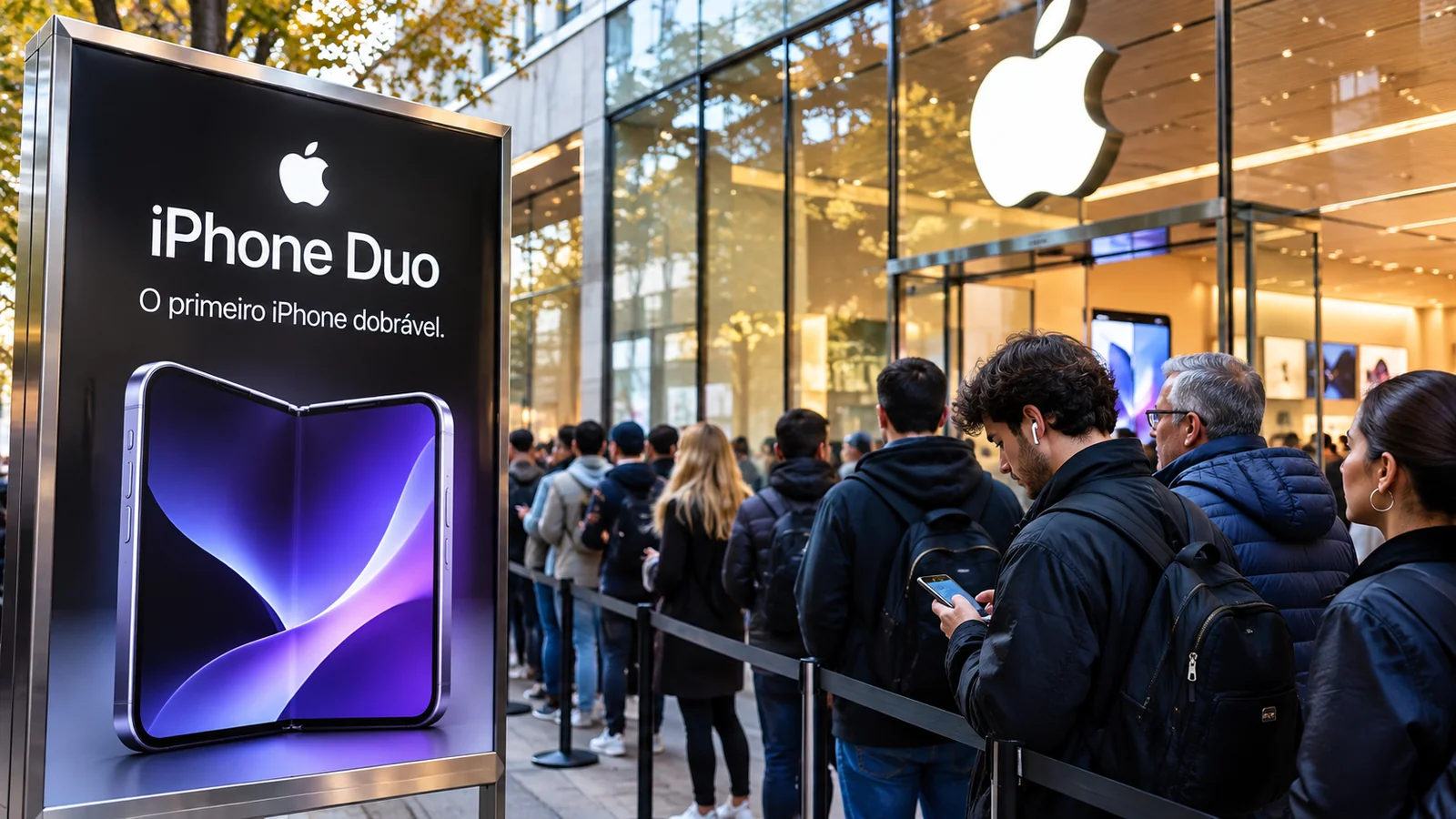
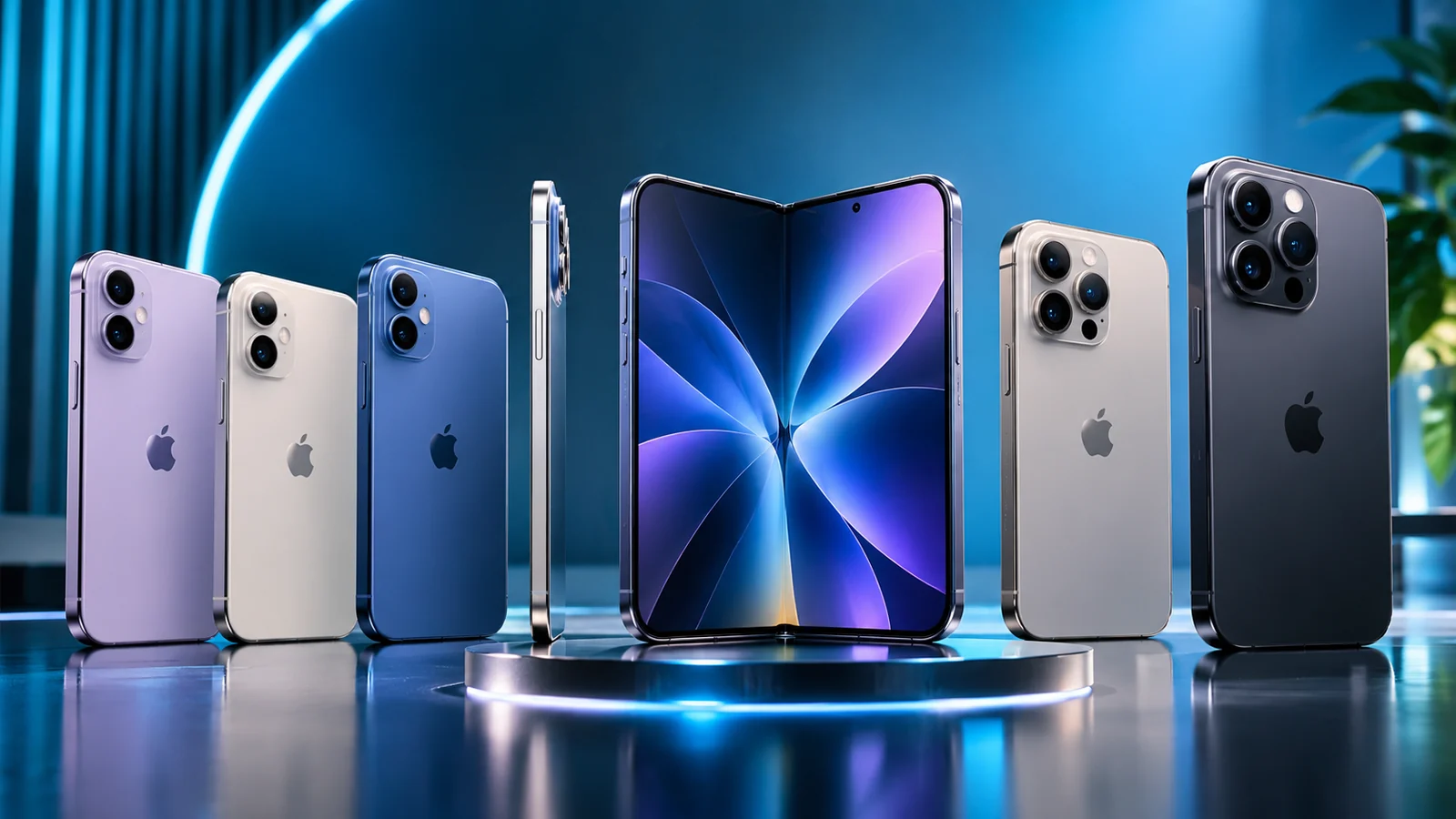
The official Portuguese line-up, including the new foldable Duo, compared by purpose, price and practical trade-offs.
Editorial note. Information verified against the Portuguese Apple Store on 11 November 2026. Prices and availability may change; no independent hands-on test is claimed.
The iPhone range on 11 November 2026: six families with different purposes
Apple’s Portuguese online store, checked on 11 November 2026, lists six families: iPhone Duo, iPhone 18 Pro and 18 Pro Max, iPhone Air, iPhone 17, iPhone 17e, and iPhone 16. There are six families, although the Pro line offers two sizes. Keeping that distinction clear avoids confusing the number of models with the number of product ranges.
Buying an iPhone is no longer just a question of choosing the newest device. The range includes a foldable for new ways of working, two Pro models for demanding photography and performance, an Air designed around lightness, two more balanced options, and an older generation that remains available. This guide explains the purpose of each one and the trade-offs, without treating advertising claims as a substitute for individual needs.
iPhone Duo: the first foldable changes the shape of the range
The iPhone Duo is the clearest departure from the conventional iPhone: Apple’s first foldable model, with two displays and several possible positions. Its internal OLED panel measures 7.6 inches, while the external display is 5.4 inches according to Apple’s specifications. Open, the phone gives you more room for documents, reading, video, and side-by-side apps. Closed, it behaves like a compact phone, although it is thicker than a conventional slab device.
It should not be seen as an automatic replacement for the Pro Max. Duo prioritises flexibility and screen area, rather than necessarily providing the most extensive camera setup. Apple confirms an A20 Pro chip and a 48MP Dual Fusion camera system. People who spend their time in maps, notes, video calls, messaging, and reading may see a tangible benefit. For someone interested primarily in sophisticated photography and simplicity, a Pro may be the more appropriate tool.
It is also the most expensive model in the line-up, starting at €2,399 in the Portuguese online store checked for this article. Consider ergonomics, hinge durability, weight, repair costs, case compatibility, and whether you will really open the inner display every day. Apple lists a weight of 254g. The illustration accompanying this article represents the foldable concept, rather than an official photograph of every finish.
iPhone 18 Pro and Pro Max: the most comprehensive conventional flagship
The iPhone 18 Pro and 18 Pro Max are the leading conventional flagship options. The smaller Pro has a 6.3-inch OLED display, while Pro Max increases that to 6.9 inches. Both feature ProMotion up to 120Hz, the A20 Pro processor, and a camera system with more creative flexibility, including a 48MP Fusion main camera with variable aperture.
The most immediate difference between the two is size, with consequences for weight, handling, and battery life. Pro Max is a natural fit for people who prefer a large screen for photography, editing, data analysis, and media consumption; Pro brings similar ambition to a more manageable form. Bigger is not automatically better: heavy one-handed use may favour the smaller model.
Apple’s Portuguese shop presents the Pro family from €1,499. That is the starting price for the family, not a price claim for Pro Max. Anyone doing serious photography, video editing, or demanding application work should compare storage, cameras, and battery specifications directly. For ordinary everyday tasks, the technical advantage may not deliver a proportional practical benefit.
iPhone Air: lightness is a feature, not just a design statement
The iPhone Air stands apart with a body 5.64mm thick, weighing 165g, and a 6.5-inch OLED display offering ProMotion up to 120Hz. Its aim is to offer a premium experience with less bulk in a pocket and less weight in the hand. Ergonomics can be a real advantage for people who spend hours reading, writing, and navigating on their phone.
The official starting price checked for this article is €1,349. Buyers should decide whether thinness is worth the potential differences in camera options and battery margin compared with the Pro line. Anyone who needs versatile photography, professional recording, or long stretches away from a charger should review the specifications closely. Air is not merely a cheaper Pro; its priorities are deliberately different.
iPhone 17: a balanced choice for everyday needs
The iPhone 17 remains part of the line-up because it balances features, price, and useful life. Apple’s specifications describe a 6.3-inch OLED display with ProMotion up to 120Hz, along with a capable platform for communication, everyday photography, applications, and Apple services. For many buyers, this combination avoids paying a premium for advanced tools they may rarely use.
The Portuguese shop currently lists it from €1,139. Rather than looking only at the generation number, check storage capacity, intended years of ownership, zoom requirements, display size, and retailer discounts. If photography is not your profession and you do not need the largest screen, this family should be among the first you compare.
iPhone 17e: a lower entry price with conscious trade-offs
The iPhone 17e has the lowest listed starting price among the six families: from €889 in Portugal. Its key argument is access to the iPhone ecosystem and essential features without the price of Pro, Air, or Duo.
That does not mean the features are identical to those of iPhone 17. Compare the display, cameras, storage options, and specific features before deciding. What matters most is what you actually use: calls, messages, navigation, family photos, authentication services, and work apps. A lower initial price is valuable when the compromises will not interfere with your needs over the following years.
iPhone 16: an older generation is not automatically the cheapest
The continued presence of iPhone 16 demonstrates that Apple still sells a previous generation. Its displayed starting price in the Portuguese store is €1,039, more than the entry price of iPhone 17e. That is not a contradiction: these are different models with distinct features, configurations, and positioning, rather than a simple sequence where an older number always costs less.
Compare specific models, promotional prices from retailers, colour and storage availability, and expected software support. An iPhone 16 on promotion may be competitive for some people. Others may find a new 17e or a better-equipped 17 the more coherent purchase. Release date alone should never determine value.
Reference prices: avoid confusing product families and configurations
On 11 November 2026, Apple’s Portuguese online store showed these starting prices: Duo €2,399; the 18 Pro family €1,499; Air €1,349; 17 €1,139; 17e €889; and 16 €1,039. These are reference starting prices, not guaranteed prices across all colours, capacities, or sizes. Pro Max, for example, has its own price within the broader Pro family.
The practical questions that separate the models
Six questions help. First: do you need a folding screen and two working areas? If so, explore Duo. Second: are photography and video central to your work? Put the 18 Pro line at the top of your shortlist. Third: is comfort and light weight your priority? Consider Air. Fourth: do you want balance without flagship prices? Start with 17.
Fifth: is your budget strict and are your needs mainly essential? Compare 17e with 16, specification by specification. Sixth: how long do you plan to keep the phone? A four- or five-year ownership horizon makes battery health, repair options, and storage more important. These questions reduce the risk of buying an exciting new device that does not actually match your daily routine.
Buying in Portugal: availability, warranty, and up-to-date details
Before ordering, confirm the exact model reference, storage, colour, final price, delivery schedule, and return conditions with the seller. Apple and authorised retailers may have different stock and promotions. It is also wise to compare repair costs and locally available support, particularly for expensive devices or phones with a foldable screen.
This article reflects the catalogue verified on 11 November 2026. Apple may change prices, availability, and the models on sale. The final purchase should rely on current specifications and the selling conditions shown at checkout. This overview does not replace an independent hands-on review.
Summary: there is no one best iPhone for everyone
Duo is the option for exploring a different form factor; 18 Pro models concentrate the most complete camera and performance tools; Air prioritises lightness; 17 aims for balance; 17e lowers the initial investment; and 16 remains an alternative from the previous generation. The order of preference will change according to budget and priorities.
Prices and model names were checked on 11 November 2026. For technical specifications, also consult the official comparison chart and individual product pages.
View official sourceFurther reading: Apple iPhone Duo · iPhone 18 Pro · iPhone Air · iPhone 17 · Compare models
Key takeaways
The right choice depends on needs, total cost, and the length of time you intend to keep the device. Confirm the details with Apple before purchasing.