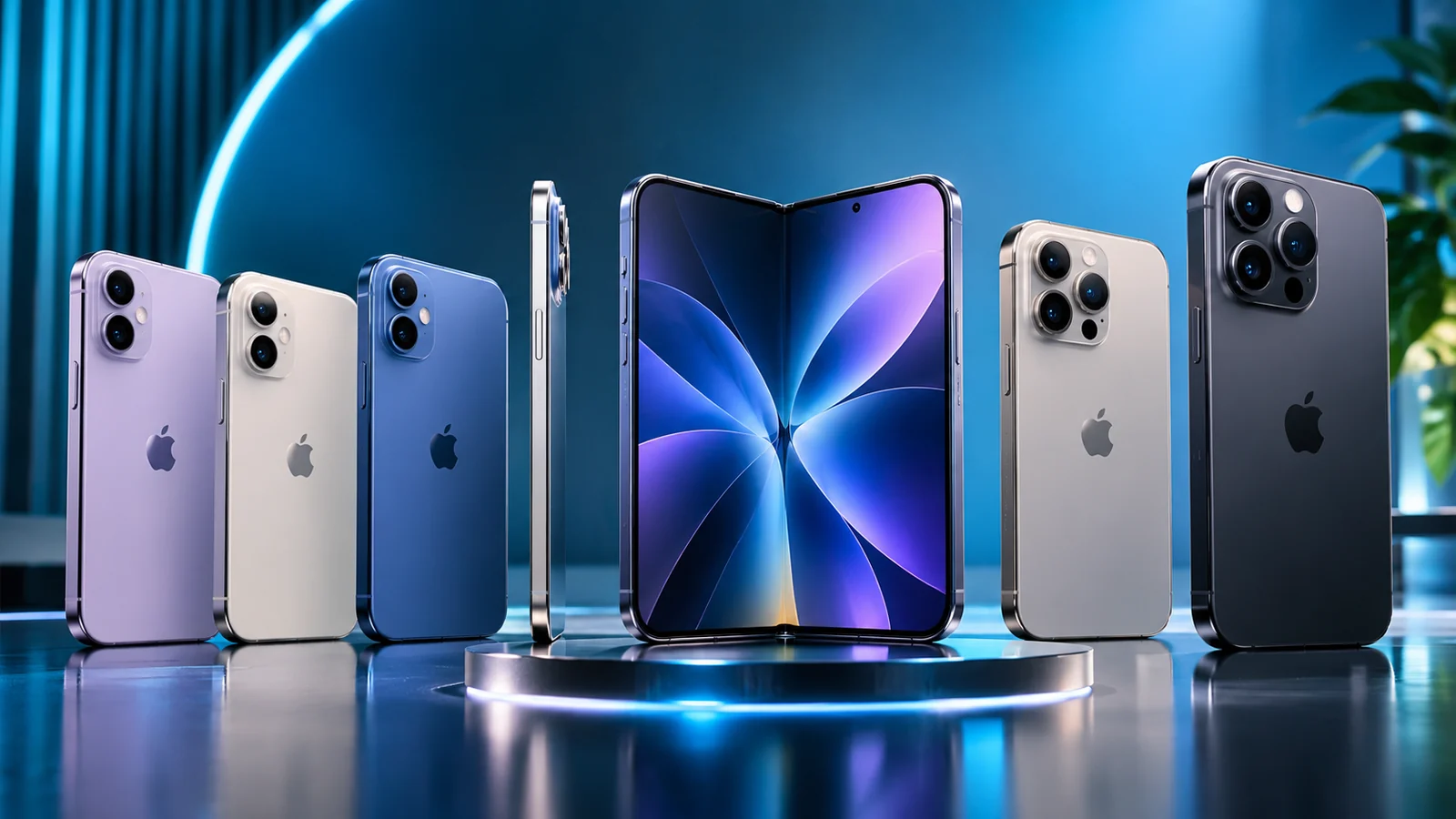
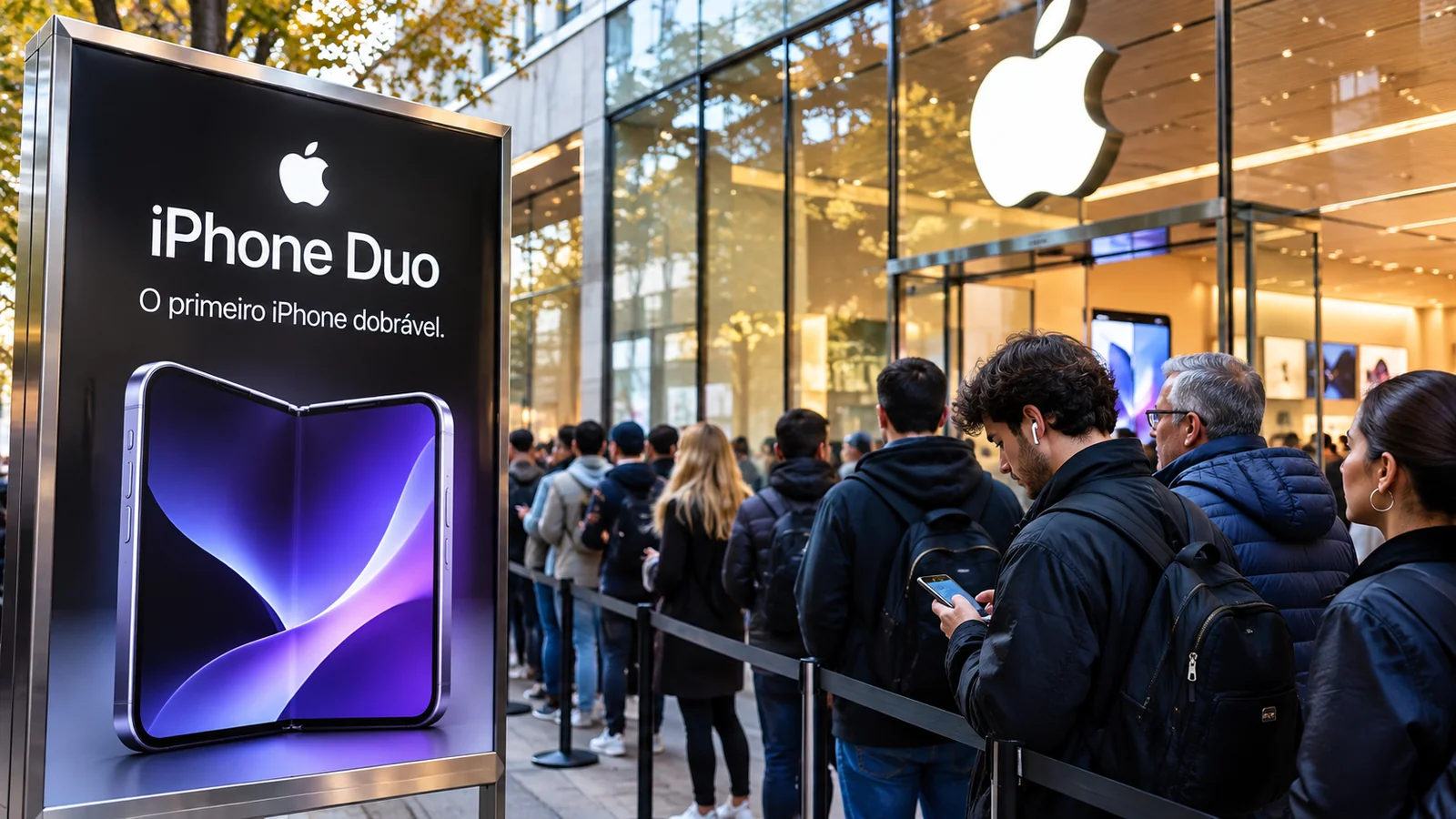
In November 2026, imagining Apple five years from now requires starting with what is already real. iPhone Duo opened a new form-factor category, Siri AI moved beyond the promise stage, and HomeView brought Apple's intelligence into the home. What could happen between 2027 and 2031? This analysis separates confirmed announcements, specialist reporting and editorial scenarios rather than presenting forecasts as official product schedules.
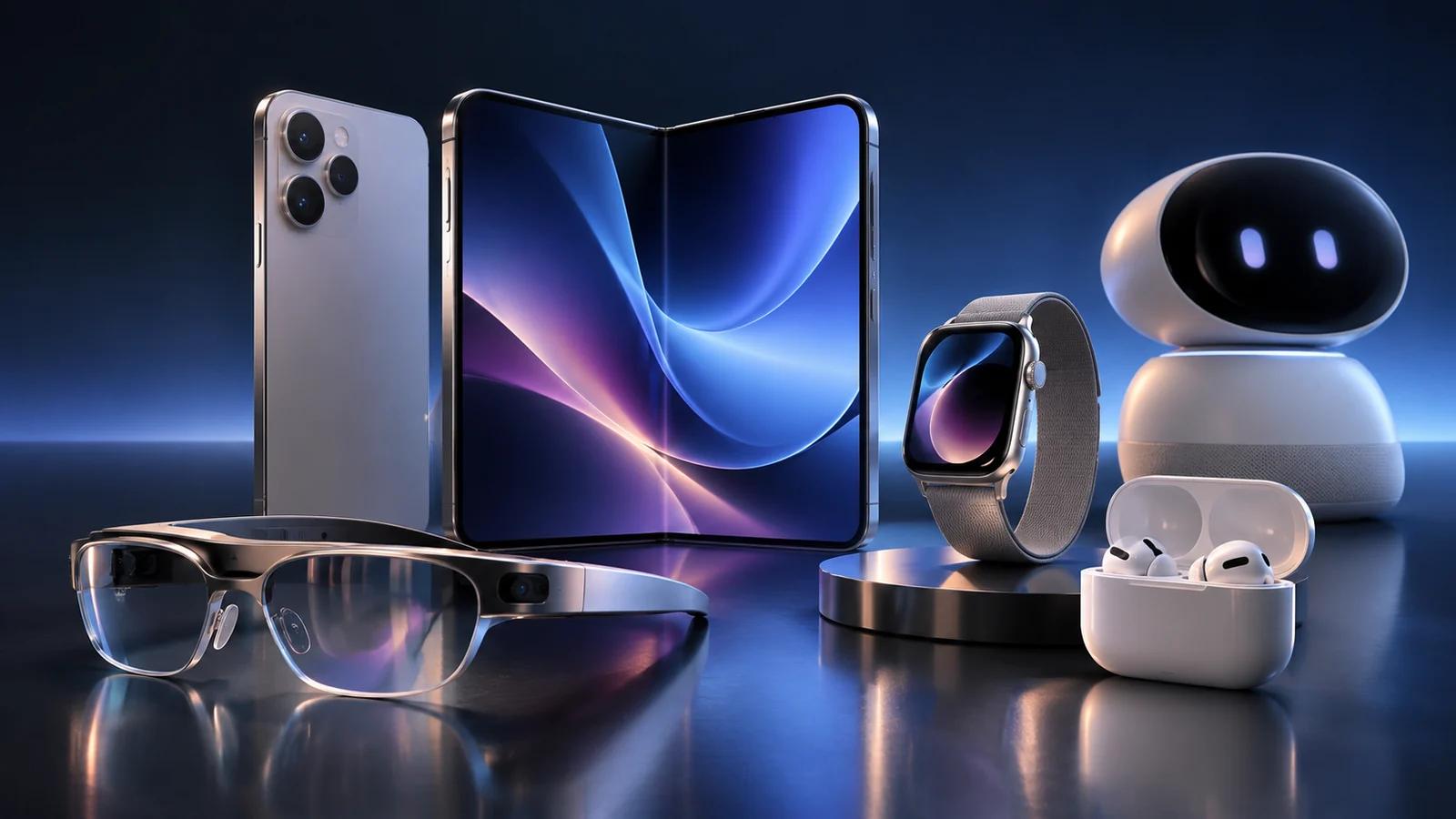
Editorial note. Updated 11 November 2026. Confirmed = announced by Apple; reported = specialist media coverage; scenario = editorial forecast. No 2027–2031 launch date is presented as certain.
The starting point in November 2026
Apple enters this period with several visible development fronts. iPhone Duo, introduced in October, shows a willingness to explore foldable designs, with software built to take advantage of a larger screen. Siri AI, introduced in 2026, combines conversation, context and integration across apps and devices. HomeView creates another Apple presence in the home. These are facts, not rumours.
The same applies to advances in health monitoring on Apple Watch and Apple silicon processors, where AI capabilities have gained importance. The question over the next five years is not whether these fields exist. It is how fast they can mature, reach users in Portugal and offer enough practical value to justify a purchase. Apple has not published a comprehensive product roadmap through 2031.
2027: twenty years of iPhone and the next steps for Duo
The original iPhone was introduced on 9 January 2007. Its twentieth anniversary in 2027 offers a natural opportunity for a retrospective or a commemorative release. That does not prove Apple will launch a special anniversary model, an uninterrupted edge-to-edge screen or a radically different design. Those are plausible editorial hypotheses, not announcements.
A more concrete direction begins with Duo: improving hinges, thickness, durability, continuity between screens and productivity. A later generation might reduce compromises commonly associated with foldables, but neither its cadence, name nor features have been confirmed. For Portuguese buyers, repair options, durability and price could matter as much as visual novelty. The reasonable expectation for 2027 is refinement of a concept rather than a guaranteed redesign of the entire iPhone family.
2028: artificial intelligence changes everyday use
Between 2027 and 2028, the most important upgrade may be neither a button nor a camera. Siri AI already offers a foundation for natural language requests. The next step might be chaining actions across apps, interpreting intentions more reliably and requesting approval before modifying data, sending messages or making purchases. This is a reasonable technological direction, not a list of officially promised 2028 features.
The experience will depend on model quality, reliability, transparent permissions and error recovery. If an assistant completes five steps but fails on the sixth, much of the benefit disappears. The hard problem is less about impressive answers and more about predictable execution with genuine user control. Innovation should save time without requiring constant supervision.
Siri and Apple Intelligence: what really changes
The Apple ecosystem has a functional advantage: iPhone, Mac, iPad, Watch and other devices share apps, accounts and parts of the user's context. This may make it easier to start a task on one device and continue on another. Siri's evolution must distinguish between recommending an action, reading information and actually modifying personal data.
Privacy will remain a competitive consideration. On-device processing, remote infrastructure, data retention and permissions have different implications. It is also important not to project the US experience onto Portugal. Language support, services and features may vary by region. Apple acknowledged restrictions affecting some functions in the European Union in 2026. Sound forecasting needs to include those regulatory differences rather than assuming simultaneous global availability.
Smart glasses: a possibility, not a confirmed release
Specialist reporting in 2026 described projects involving iPhone-connected smart glasses. The most plausible initial product might focus on audio, cameras, contextual information and assistants rather than a full-time augmented-reality image projected into the lenses. Apple has not announced specifications or a sales date for such glasses.
To gain traction, wearables must solve weight, comfort, battery life, privacy in public spaces and everyday usefulness. A device that merely repeats notifications may have a limited market. Something discreet that helps with translation, navigation or contextual information, while respecting consent, offers a more compelling proposition. A potential 2027 or 2028 release remains a report or rumour, not a promise.
Spatial computing: beyond Vision Pro
Apple Vision Pro illustrates a spatial computing approach built around three-dimensional interfaces and digital content integration. That does not mean the product will quickly become mainstream. Price, weight, comfort and the availability of useful software remain important constraints for this category.
By 2031, it is reasonable to explore the prospect of lighter hardware with better battery life and more practical uses for work, education or entertainment. Another possibility is that spatial experiences are distributed across glasses, iPhone and Mac, rather than relying on a single headset. These are possibilities with considerable technical and commercial uncertainty. Having a platform does not mean every imaginable device will eventually ship.
Apple Watch and health: useful insight matters more than sensors
In 2026, Apple announced enhanced sensing in Apple Watch Series 12 and Ultra 4, including new heart-rate and heart-rate-variability measurements and readiness insights. In the years ahead, a plausible direction is better contextual interpretation of those signals, combining activity, sleep and individual baselines.
Collecting more data is not the same as diagnosing disease. Features making clinical claims require proper validation, clear limitations and, where applicable, regulatory clearance. Another form of innovation is making results understandable without creating unnecessary alarms. A watch with fewer but more evidence-based recommendations may be more useful than a long list of sensors. Many frequently discussed health technologies have no confirmed Apple implementation timetable.
Apple silicon and Mac: performance, efficiency and on-device AI
Processor development is one of the most predictable parts of Apple's strategy, although the names of future chips are not. In 2026, Apple introduced M6 using a 2-nanometre manufacturing process and placed an explicit emphasis on AI capabilities. Future progress may focus on the relationship between performance, energy use and sustained computing power.
For professional users, that matters more than headline speeds. Exporting video, running AI models, processing photographs or switching among demanding apps without draining the battery are measurable improvements. Display technology, thermal efficiency and service integration might also matter. Specific processors, models and prices for 2029 to 2031 cannot be guaranteed; the evidence-based scenario is continued evolution of Apple's proprietary hardware.
Smart home: HomeView exists, while robotics remains speculative
HomeView was officially announced in October 2026 as a smart-home platform with a display, Siri AI, communication and device controls. It would therefore be incorrect to describe it as a future unannounced product. What could evolve is its ability to coordinate household tasks, remove setup friction and operate with devices from multiple manufacturers.
Robotics is a higher-risk leap. Reporting based on sources familiar with Apple's plans describes research into moving home devices, including displays mounted on robotic arms. Neither those concepts nor a possible home companion robot should be presented as confirmed launches. Between a lab demonstration and a dependable consumer robot lie major challenges involving safety, price, maintenance and privacy. The category could grow, or the most ambitious experiments could remain unreleased.
2029 and 2030: less dependence on a single screen
If AI improves and new wearables emerge, some tasks currently handled on a phone might move to voice, earbuds, watches or glasses. This does not imply that iPhone will disappear. Screens remain valuable for typing, photography, reading, video and demanding work. A gradual shift towards complementary interfaces is more plausible than a sudden replacement.
In 2029 or 2030, the most important benefit may be continuity: receive an instruction on Watch, review information on iPhone and complete a task on Mac without starting over. Success will depend on interoperability, AI accuracy and control of personal data. The same ecosystem that simplifies tasks can also increase switching costs and dependency on services. That trade-off belongs in a balanced analysis.
2031: a possible vision, not a launch calendar
Looking towards 2031 requires accepting high uncertainty. One can imagine a family of devices in which foldable iPhone, watch, glasses, Mac and smart-home equipment cooperate through a personal intelligence layer. Rather than opening many apps manually, users could set goals and approve specific actions. Interfaces might change, but physical devices would still matter.
It is equally possible that some ideas will fail. High costs, inadequate battery life, low consumer demand or legal barriers can hold back technically promising products. Technology history contains many concepts that look extraordinary in demos but offer too little everyday value. Presenting an imaginary “2031 iPhone” or a home robot as certain would therefore be editorially misleading.
What might actually justify upgrading an iPhone
For someone with a recent iPhone, not every launch carries the same value. Improvements that meaningfully change usage might justify an upgrade: substantially longer battery life, a genuinely useful foldable format, new photographic capabilities or reliable AI features requiring more recent hardware. Minor speed gains, colour changes or subtle aesthetic differences may not justify the cost.
A sensible framework compares five dimensions: tasks completed, battery life, durability, software support and total cost of ownership. Purchase price should not be separated from repairability or resale value. Portuguese buyers must also consider Portuguese-language availability, mobile-network compatibility, service access and warranty terms. Apple's future can be exciting without rendering yesterday's purchases obsolete.
How to read forecasts without confusing rumours and facts
This analysis uses three levels of confidence. Confirmed means Apple has announced or released the product: Duo, Siri AI, HomeView and Apple silicon M6 fall into this category in 2026. Reported means credible journalists have described plans or prototypes, such as smart glasses or some robotics concepts; they might change or be cancelled. Editorial scenario refers to an inference built from trends and constraints, without privileged inside information.
The distinction matters especially across five years. A rumour repeated by dozens of websites does not become an official announcement. A possible date should never be confused with a retail release schedule, and international availability should not be inferred from US availability. Readers deserve to know the evidence level behind each claim.
Conclusion: more integration, fewer certainties about dates
Between 2027 and 2031, Apple could advance across five fronts: flexible formats, more capable personal intelligence, spatial computing, connected health and home automation. Research and development investment provides the capacity to explore multiple options, but it does not guarantee that every one becomes a commercially successful product. In 2026, the company's research and development spending reached $45.765 billion across its businesses.
The most important change may be less visible than a new gadget: devices working together to solve real problems. For buyers, the question remains straightforward: what can this technology help me do better? Answering with evidence, caution and concrete criteria is more useful than promising a revolution every year.
Frequently asked questions
Has Apple confirmed smart glasses for 2027?
No. Specialist reports discuss projects and possible timelines, but Apple has not announced a confirmed sales schedule for those glasses.
Is iPhone Duo already a real product?
Yes. Apple introduced iPhone Duo in October 2026. This article discusses possible future developments without promising a second generation.
Does Siri AI already exist in 2026?
Yes. Apple announced new Siri AI capabilities in September 2026, with availability depending on supported languages, devices and regions.
Should I wait until 2030 to buy an iPhone?
There is no universal answer. If you need a phone now, compare current needs, support and budget; forecasts alone are not a good reason to postpone every purchase.
Official sources support confirmed events; media reporting on unannounced devices is explicitly identified. Checked: 11 November 2026.
What matters most
From 2027 to 2031, the most meaningful opportunities may lie in device integration and genuinely useful services. Exciting possibilities are not the same as promised release dates.