Can the iPhone Duo replace an iPad mini? We compare screens, weight, multitasking, Apple Pencil, cameras and cost to see where phone ends and tablet begins.
Editorial note. Based on Apple’s published specifications; this is not a hands-on device test.
A question bigger than screen size
Apple’s 2026 iPhone Duo changes the relationship between phone and tablet. Closed, it is a pocketable device for calls, messages, photos and payments. Open, it offers a screen large enough for reading, comparing documents and viewing two applications at once. That is why asking whether it is an iPhone or an iPad makes sense: its physical shape overlaps two categories that previously served different routines.
Technically the answer is clear: Duo runs iOS 27 and is an iPhone. In practice, replacing a tablet involves more than diagonal screen measurements. Apps, multitasking, accessories, hours of comfortable use and total cost all matter. This comparison identifies the moments when a folding phone can substitute for an iPad mini and the situations where owning two devices still offers more freedom.
7.6 versus 8.5 inches: closer than expected
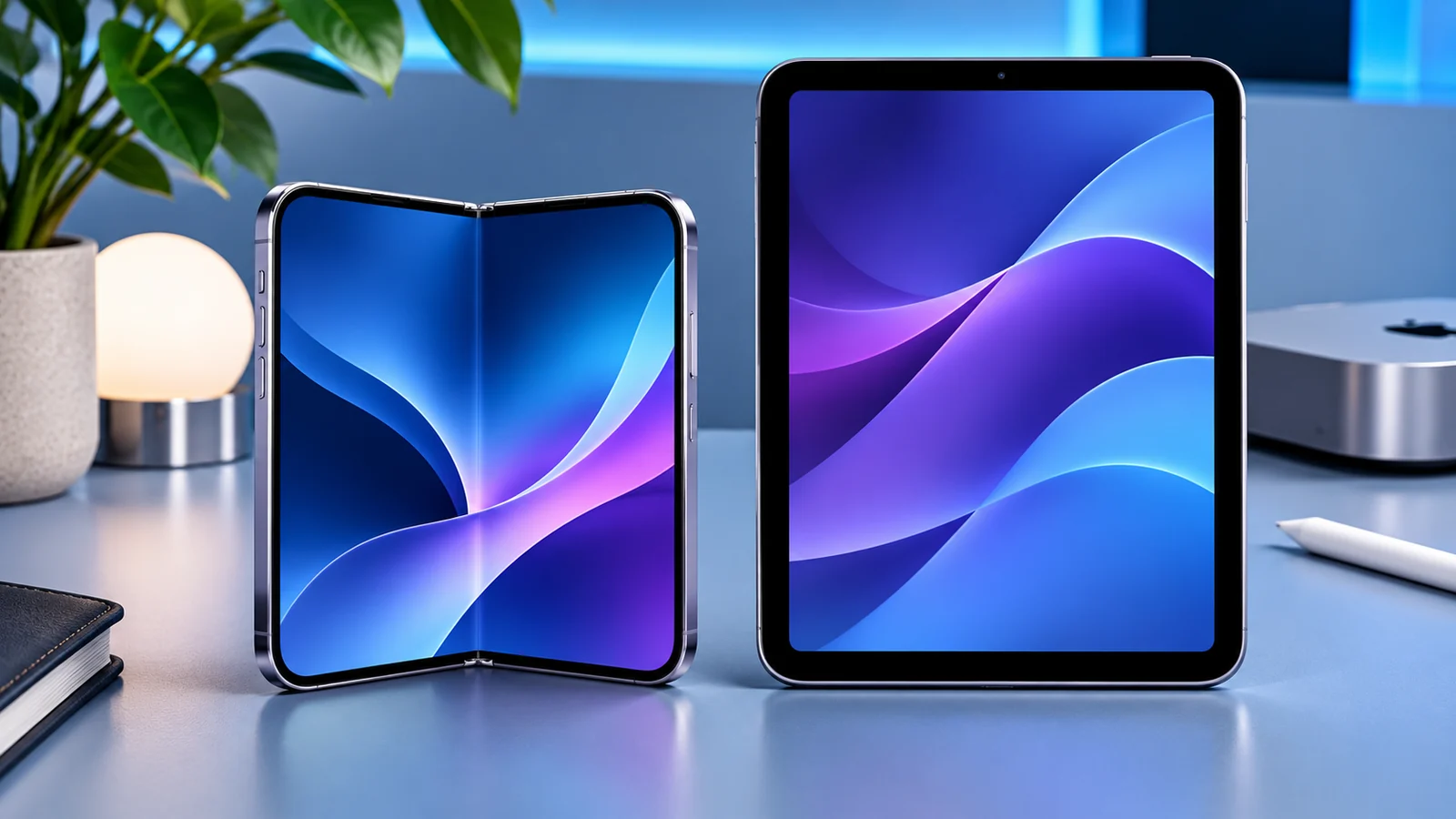
Duo has a 7.6-inch folding OLED display inside and a 5.4-inch outer screen. The larger display is revealed only when opened; the smaller one handles quick phone tasks. Apple’s newly updated 2026 iPad mini has a permanent 8.5-inch OLED screen. These figures come from the manufacturer, yet diagonal dimensions alone cannot describe usable workspace: display shape, app layout and screen controls matter as well.
For news, maps, email and long webpages, the opened Duo offers far more room than a conventional phone. For extended annotation, illustration and detailed document work, the mini retains a larger and more stable surface. The deciding question is how often the user will open the Duo and how long each work session lasts.
254 versus 255 grams: the portability paradox
Perhaps the most surprising specification is weight. The iPhone Duo is listed at 254 grams, while the new iPad mini Wi-Fi is 255 grams: a difference of just one gram. Their shapes, however, could hardly be more different. Duo closes to a 84.1-mm-wide, 11.3-mm-thick body. The mini has the usual tablet footprint of 195.3 by 132.6 mm and a 5.4-mm thickness.
Duo is better suited to a pocket, albeit thicker when folded. The mini is more comfortable as a permanent flat screen in a bag or on a desk. Travellers hoping to carry fewer devices may appreciate Duo. People reading or working for hours may prefer the uninterrupted tablet shape. Ergonomics cannot be inferred from weight alone.
iOS 27 versus iPadOS 27
Software remains a meaningful dividing line. Duo uses iOS 27, enhanced for foldable interactions. Apple documents Split View for two apps and multiple windows within an app, such as Safari tabs or an email inbox beside a draft. This goes beyond simply stretching a conventional iPhone interface across a larger panel.
The iPad mini runs iPadOS 27, designed around tablet interactions and workflows. That does not make every iPad application superior, but it means users should not assume complete feature parity across operating systems. Before buying either product for a specialised task, verify which app edition is available, which tools work and how controls fit the screen. A professional workflow can depend on one feature absent from the other platform.
Multitasking: useful progress with real limits
Consider reviewing a quotation while replying to a client. Two simultaneous apps on Duo could save repeated switching. The same benefit appears when comparing a map with a calendar, taking notes from a webpage or checking a recipe beside a shopping list. The partially opened form can also help place the device on a surface without a separate stand.
However, two compact windows are not equivalent to an unrestricted tablet desktop. Toolbars, keyboards and applications poorly optimised for the folding layout can use up much of the screen. The mini is naturally geared towards longer tablet sessions and its own set of iPadOS tools. Without side-by-side hands-on testing of the same applications, the fair conclusion is that Duo improves mobile multitasking rather than reproducing every iPad workflow.
Apple Pencil: an easily missed distinction
Contrary to a common assumption, the iPhone Duo officially supports Apple Pencil (USB-C). That can make the inner display useful for quick annotations, signatures and document markup, subject to app support. It is therefore inaccurate to say that Apple’s first folding iPhone cannot use a Pencil.
The 2026 iPad mini also supports Pencil (USB-C), but additionally works with Apple Pencil Pro and Apple Pencil hover. Someone marking PDFs occasionally may find Duo sufficient. An illustrator, student or designer whose work depends on Pencil Pro features and long drawing sessions has a concrete reason to choose the mini. What matters is the specific application and accessory, not simply whether a stylus is recognised.
Cameras, mobile calling and connections
Duo is built to be a primary phone. It includes a 48MP Fusion camera system, advanced photo and video capabilities, 5G, Apple Pay and a Dual eSIM design without a physical SIM slot. Using one device to capture images, receive calls, authorise purchases and review documents is central to the product’s promise.
The iPad mini can use cellular connectivity in supported configurations and handles video calls through apps, but it does not replace a conventional iPhone line in the same manner. Nor does it target the same photography role. If the goal is a single always-connected communication device, Duo has a structural advantage. If the goal is an additional reading and working screen alongside an existing phone, the mini remains a logical option.
Reading, video, games and work
For books, websites and reports, opening Duo creates something close to a pocket-sized tablet. Yet the folding crease and app layout can affect specific content. The iPad mini’s larger fixed panel is better suited to repeated long sessions. For video and games, the screen aspect ratio often matters more than the diagonal measurement, so content should be checked in the intended apps.
At work, Duo feels like an extension of the phone for short sessions, whereas mini is a separate tablet with its own workflow. Both use Apple’s A20 Pro family, although configuration, cooling and sustained performance can differ. Chip names alone do not constitute an independent performance test. A thoughtful comparison asks what tasks each form factor makes easier, not which device appears more dramatic in marketing photos.
Durability: a hinge adds a variable
Duo uses a folding titanium structure and a flexible screen. That engineering enables pocketability but adds components and care considerations around cases, impacts, particles and repairs. Apple lists IP68 resistance for Duo, which is not the same as immunity to wear or accidental damage. Warranty and service terms deserve attention.
The new mini carries an IP67 rating and a conventional, non-folding tablet structure. That does not make it indestructible; glass can break on either device. Total ownership cost should include protection, service pricing, parts availability and how the device will be carried. A water-resistance rating alone cannot settle the long-term reliability question.
Battery life: compare like with like
Apple states that Duo can deliver up to 31 hours of video playback on its internal screen and up to 44 hours on its external screen. These are controlled manufacturer measurements, not guarantees during cellular use, demanding games or sustained split-screen work. Running the larger panel consistently changes the power requirement.
The iPad mini has a different usage pattern and published test approach. Comparing manufacturer endurance claims under different conditions can be misleading. A fair test would measure reading, streaming, video calls, multitasking and charging intervals under comparable settings. Without such tests, battery life should be assessed as a user-specific requirement rather than presented as a simplistic winner.
Cost in Portugal: one product or two?
Apple Portugal lists iPhone Duo from €2,399 for the 256GB configuration, as consulted on November 11, 2026. That is a premium purchase. iPad mini is positioned much lower, but comparing sticker prices alone misses the real choice. One option is Duo as a single everyday device; the alternative may be a conventional iPhone plus an iPad mini.
Anyone who already owns a recent iPhone and mainly wants a better screen for reading, drawing or reference material may obtain greater value from the mini. Buyers replacing their phone who expect to use the foldable screen every day might justify Duo instead. Consider storage, stylus, case, insurance and repair costs. Retail prices and availability change, so they should always be checked again before purchasing.
Verdict: a phone with some tablet strengths
The iPhone Duo is an iPhone that takes on several jobs once associated with small tablets. Its strength is the ability to move from immediate phone tasks to broader reading and multitasking without bringing another device. Split View and Pencil (USB-C) support make that crossover genuinely useful for some people.
The iPad mini still has strengths of its own: an 8.5-inch permanent display, iPadOS, Pencil Pro compatibility and a device shape suited to extended sessions. Neither is universally better. People whose work or studies already rely heavily on iPad workflows may see Duo as complementary. Those who use their mini only occasionally and prize portability might be able to retire it. The right question is not which category label wins, but which everyday tasks can be done well on one device.
Official sources and documentation
Consulted on November 11, 2026. Product specifications and prices may change.
Frequently asked questions
Can iPhone Duo completely replace an iPad mini?
Not for everyone. It can cover reading and light multitasking, while iPadOS, the larger fixed display and Pencil Pro remain reasons to own the mini.
Does iPhone Duo work with Apple Pencil?
Yes. Apple officially supports Apple Pencil (USB-C). iPad mini also supports Apple Pencil Pro.
Is Duo heavier than an iPad mini?
No. The Duo weighs 254 g and the new 2026 iPad mini Wi-Fi weighs 255 g, although their shapes and handling differ.
Should I buy Duo or an iPhone and iPad mini?
It depends on what you already own and which apps you use. Duo reduces the number of devices; a separate phone and tablet offer more flexibility and different workflows.
What to remember
The Duo is a genuinely versatile phone, but it cannot automatically reproduce every iPad mini workflow. Compare your most frequent tasks before buying.
Also read: iPhone Duo vs. iPhone 18 Pro Max · Why are iPhones so expensive?